
Finding St. Louis Residents in Official Records
Use the detail already tied to the person or place. A current street address fits the county real-estate search and GIS parcel layer. A recorded owner name fits the Recorder of Deeds index. A dated household question fits the St. Louis County Library directory run. Court and vital-record sources can verify a limited fact, but they do not create an open list of people. The strongest St. Louis residents directory search keeps the role clear: owner of record, party to a case, registered voter, or directory-listed household are different descriptions.
Start broad enough to catch spelling and municipal-label changes, then narrow with an identifier. Save the county locator, legal description, deed book/page, directory year, scan page, or case number. Those details make the next request repeatable. A no-result can reflect the 1876 City of St. Louis and county split, an old street label, a protected record, OCR trouble, or a portal with limited online coverage.
- Run a known address, owner name, locator, or subdivision through the county property search and preserve the result identifiers.
- Use GIS to compare the property address, owner mailing field, municipality, ZIP, and parcel geometry before drawing a conclusion.
- Follow a deed book/page to the Recorder, then search grantor and grantee names only as the instrument supports them.
- For an earlier household, search the library’s county directories by surname and, where present, by the reverse-address section.
- When the needed record is not public online, ask the named custodian for a copy, terminal procedure, or a focused Sunshine Law request.
St. Louis County Parcel Search Fields
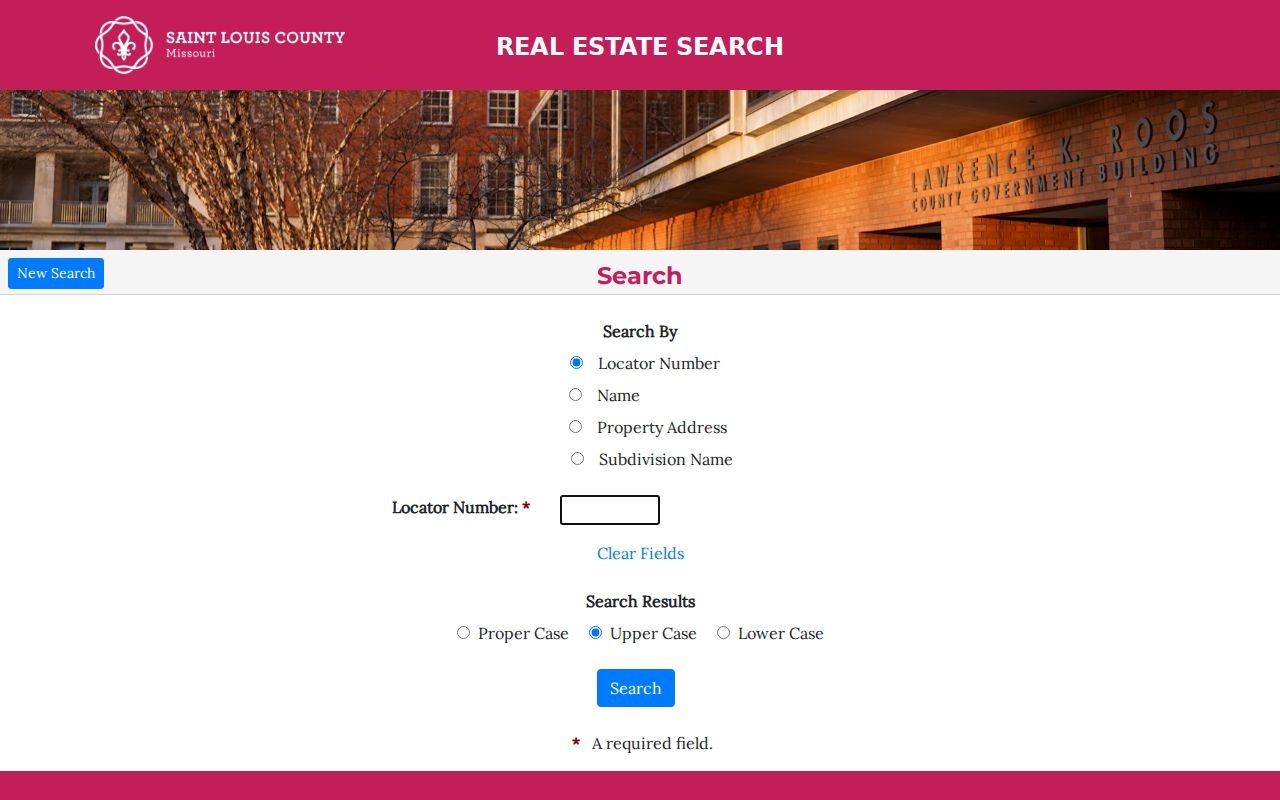
The St. Louis County Real Estate Search is the most direct starting point for a current parcel clue. It provides separate search paths instead of one free-form box. Use the property-address route for an address, the locator route when a prior record supplied that key, and the name route only when the owner name is the documented lead. A result can show current assessment and building context, but it should not be converted into an assertion about every person at an address.
| County search field | Type | Use in a residents search |
|---|---|---|
| Locator Number | Selected route and text field | A repeatable parcel key; the portal requires a letter in the third position and no spaces. |
| Search by Name | Selected route | Finds an owner-of-record lead, not proof of residence. |
| Property Address | Selected route | Uses street number, street name, optional direction, and optional suffix. |
| Subdivision Name | Selected route and text field | Useful where a recorded subdivision name is known. |
The screenshot from the county’s Real Estate Search shows the separate locator, name, address, and subdivision routes.
That division is useful because a parcel locator survives many variations in street suffixes and mailing labels.
Note: Preserve the portal’s displayed tax year and record date with any parcel result because county fields and map layers can change.
St. Louis GIS Separates Address Roles
The county’s GIS Property Lookup adds map geometry to the Revenue result. Its parcel layer distinguishes the situs fields, such as property address and property ZIP, from owner mailing fields. It also carries legal-description, deed book/page, municipality, school, fire, library, and neighborhood fields. This is the local step that prevents a mailing address from being mistaken for a person’s location.
- Parcel
- A mapped tax-property unit identified by a county locator.
- Situs address
- The property’s physical address in the GIS field set, distinct from the owner mailing address.
- Index
- A finding tool that points to a record; it is not necessarily the underlying image or certified copy.
- Criss-cross directory
- A reverse-address section that can list a household by street rather than surname.
GIS supports a name search with last name first, an address search, a locator search, map-extent filtering, and a parcel attribute table. Zoom in before expecting detailed layers. The county warns that GIS data can be inaccurate, so confirm a vital ownership, boundary, or legal-description point with the responsible agency.
St. Louis Offices Behind Resident Records
St. Louis County records are divided by responsibility. Revenue’s real-estate search and GIS supply a parcel and current tax-record context. The Recorder of Deeds supplies recorded instruments and deed copies. The Circuit Court connects local cases to Missouri Case.net. The Missouri Secretary of State runs the voter verification route, while the library holds the county’s historical directory shelf. An official result becomes more useful when it is passed to the next custodian with its own identifier intact.
County Revenue
Real Estate Search
Parcel and assessment route
Use the official portal
Missouri Elections
State voter-verification route
County selection required
County list requests use the EIS form
St. Louis Deed Records Follow the Parcel
Once GIS supplies a deed book/page or a recorded-owner lead, use the St. Louis County Recorder search to find the instrument trail. A grantor transfers an interest; a grantee receives one. Each instrument can connect a dated name to a legal description, but it does not establish that the named party occupied the property. The county research did not expose a reliable online start year for the Recorder index, so an empty web result is not evidence that no earlier deed exists.
The Recorder’s deed-copy order form is the practical fallback when a search cannot produce a usable image. Use the property address, owner name, approximate purchase date, document type, and Recorder book/page where known. The form distinguishes Recorder book/page from the assessor’s book/page. Ask the office about a public terminal or current copy process before treating an online gap as a records gap.
The county’s Recorder search route is shown below as the instrument handoff from a parcel result.
Use a document number or book/page to request the underlying record rather than relying on a name match alone.
Current St. Louis Resident Directory Sources
No source is a complete, live St. Louis residents directory. The available rolls describe defined record roles. The county parcel layer may supply owner-of-record and property context. The voter form verifies a particular registration only when the required identity data is entered. Case.net identifies public litigants, and a Recorder record names parties to an instrument. A careful search matches the question to that limited role, then records the date and custodian.
| St. Louis source | What the record can confirm | Custodian | Access path |
|---|---|---|---|
| Real Estate Search and GIS | Current parcel, owner field, situs, legal and district context | St. Louis County Revenue/GIS | Official web search and map |
| Voter registration lookup | A specific registration result after exact identity fields | Missouri Secretary of State | Official verification form |
| Recorder instrument index | Grantor, grantee, recording and legal-description trail | Recorder of Deeds | Index, copy order, or office procedure |
| Case.net | Public party role and case events | Missouri Courts | Statewide court search route |
| County directory collection | Dated, directory-listed household or address entry | St. Louis County Library | Digitized browser, microfilm, or print |
A name that appears in more than one source still needs context. Compare the source date, record role, municipality, and address type. The focused St. Louis resident lookup process uses those comparisons to verify one person without converting a broad search into a personal profile.
St. Louis Voter Records Need Exact Data
The Missouri voter lookup is a verification form, not a browseable county roster. It asks for registered first name, registered last name, date of birth, last four digits of Social Security number, and county. Enter the details exactly as registered and select St. Louis County. A blank or blocked result does not prove that a person does not live in the county, because the form is narrow and protected participants can use substitute addresses.
For defined election information, the County Board of Elections has an EIS request form. Its permitted list outputs can include address, ZIP, precinct or split, registration date, and voting-date fields, but the form carries the use restriction in RSMo §115.158.6 and a fee schedule. Treat it as a restricted administrative request, not a shortcut to a general-purpose residents list.
St. Louis Court and Vital Record Boundaries
For a public case question, begin with the St. Louis County Courts orientation page and the Missouri Case.net route. Search a litigant as a party, record the court, case number, filing date, and role, then read the docket before relying on a hit. Witnesses, victims, children, sealed parties, and protected information may not appear. A party name is not a current-address finding.
Missouri vital records are narrower still. The DHSS application hub handles certified birth and death requests under the direct-and-tangible-interest rule in RSMo §193.255. State recording began in 1910, while deaths older than 50 years may be disclosed or transferred to the Archives under the statutes described by DHSS. The State Archives death index and pre-1910 abstracts are historical finding aids, not substitutes for a certified copy.
St. Louis Historical Directory Collections
For a dated household, the St. Louis County Library History and Genealogy collection has much more than old phone books. Its holdings include county directories, court-record transcriptions, registers, burial sources, newspapers, maps, atlases, microfilm, and local-history finding aids. The county run begins with 1893 and continues through catalogued years to 1979. Search a surname first, then use a reverse section where the volume provides one.
The library’s digitized county directory browser lets visitors select a year and search a name or part of an address where the scan supports it. Browse the alphabetical pages after a text search because OCR can miss punctuation and street abbreviations. Fragile paper volumes may not be photocopied, but the library provides microfilm readers, scans, and flash-drive copies. The Directory Book page gives the collection its full historical treatment.
The library genealogy resource shows the local-history route used for older St. Louis residents directory searches.
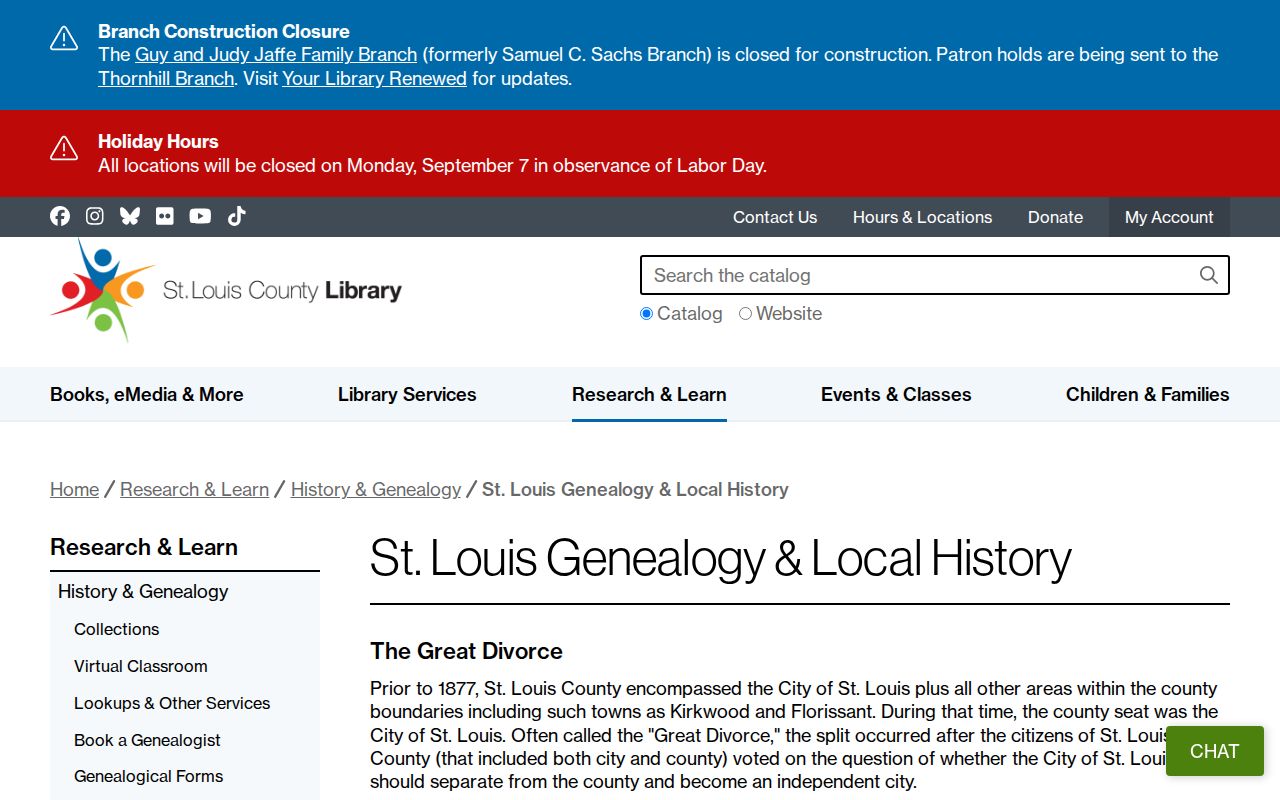
A directory entry is best cited with its title, year, page or scan, street spelling, and collection source.
St. Louis Split Records by Date
St. Louis County was organized in 1812, but the City of St. Louis separated from the county in 1876. Clayton became the county seat in 1877. That sequence changes a historical search: records made before the split may be held by City of St. Louis custodians even if later family records point to the county. An old “St. Louis” address therefore needs a date and jurisdiction check before it is sent to a county office.
This is a records-geography issue, not a minor naming detail. The library’s genealogy guidance confirms that combined city/county records were kept by the city before separation, while later county records moved toward Clayton offices. Pair an early directory, Pitzman’s Atlas from 1878, or the 1909 county plat book with the original place label. Modern GIS can then show the current municipal and parcel context without rewriting the historic address.
Note: A historic city label, ZIP label, and present municipality can all differ for the same physical place.
St. Louis State Name Sources Have Limits
When a county record identifies an organization or professional credential, move to the state record that owns that narrow topic. The Missouri Secretary of State Business Services route can supply entity name, registered agent or office, formation date, prior names, type, and status. A registered office is a legal contact field, not a personal-address conclusion. UCC filings similarly identify a transaction context, not who lives at a location.
The Division of Professional Registration directs users to board-specific licensee searches. Use it only to check the credential named in a historical directory, deed, or case record. The portal’s broad services page is shown below.
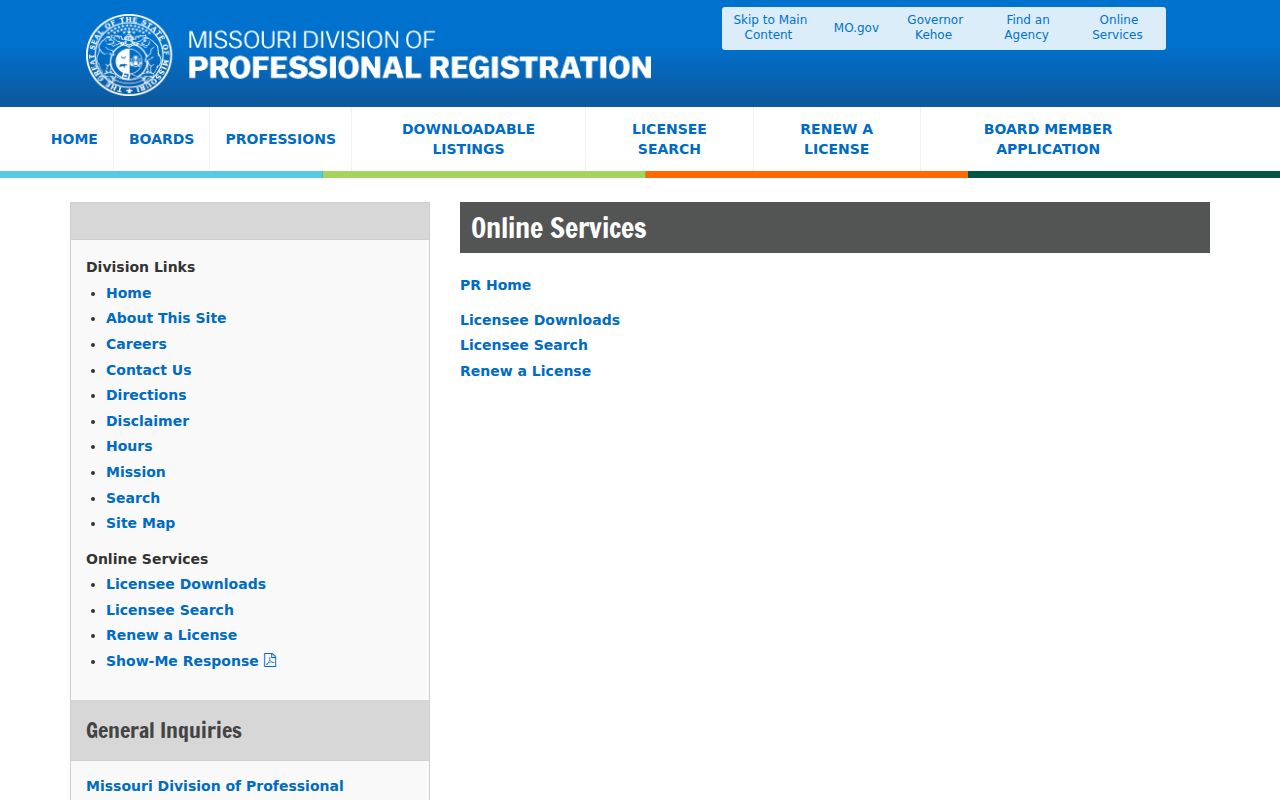
Keep the license number, status date, and board name with any result because field availability differs by profession.
St. Louis Sunshine Requests Need a Scope
Missouri’s Sunshine Law, RSMo Chapter 610, gives a request route when a record is open but lacks an online index. Under §610.023, send the request to the custodian who holds the record, identify the material and time range, and ask for a fee estimate before copying. Section 610.026 addresses copy and research fees. If something is withheld, ask for the cited exception and for segregable open portions rather than making a broad request for every record about a person.
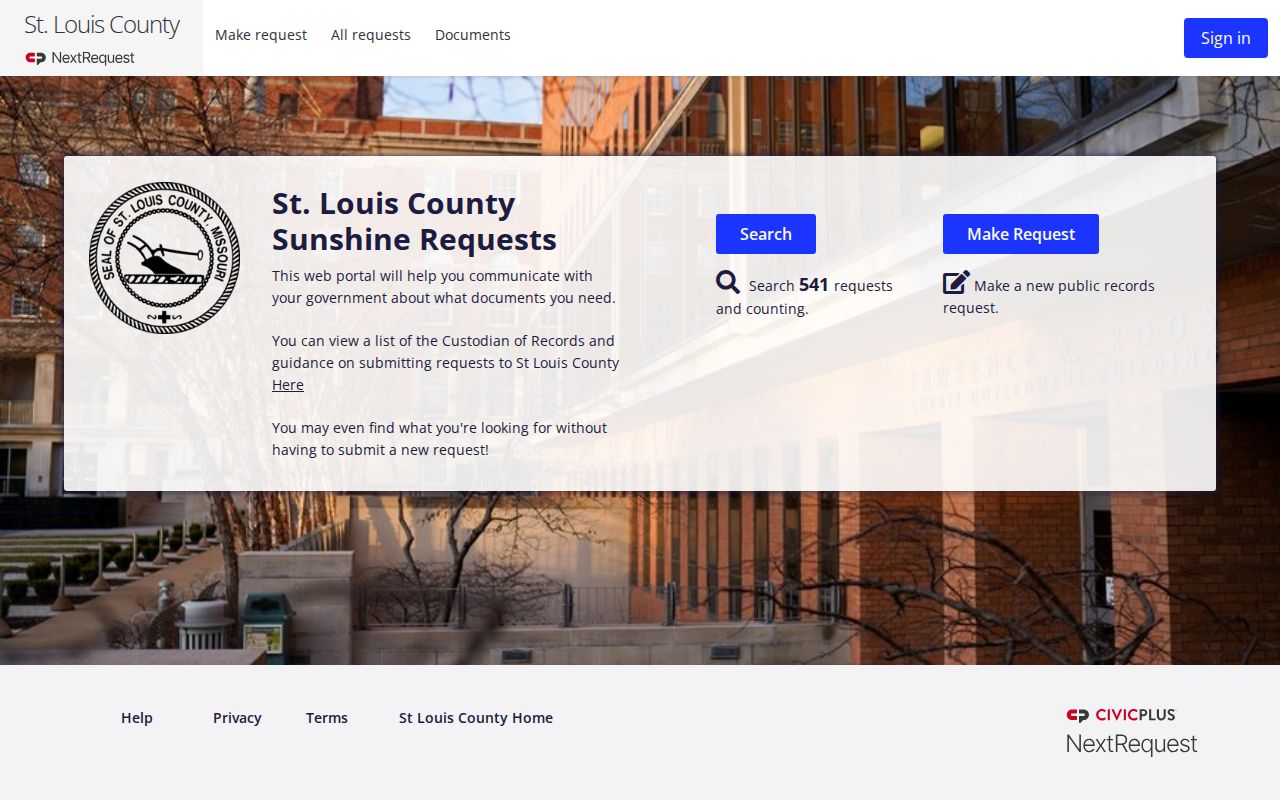
The county’s public-records request portal is the online starting point, although its exact form fields were not available during the research inspection. A department-specific request can still name the parcel locator, document number, permit number, or date range. Start with the office that owns the field: Revenue or GIS for a parcel correction, Recorder for an instrument, Circuit Clerk for a court file, and DHSS for vital-record applications.
The official St. Louis County request portal is pictured here as the request route when a direct record search cannot answer a limited question.
A narrow request with the record type and identifier is easier for a custodian to review than an open-ended name search.
Historical St. Louis Residents Directory Trails
A historical directory is a snapshot, not a current roll. It can place a printed name at an address in one edition, sometimes with an occupation or household detail. The reverse directory that began in the back of the 1922 city directory is especially useful when an address is known but the surname is uncertain. Compare neighboring years, record page numbers, and use a deed or vital record where legal proof is needed.
Commercial people-search services often blur dates and record roles. Official county, state, and library sources make the date, custodian, and evidence trail clearer, even when the work is slower. Missouri Safe at Home participants can have substitute addresses, court parties can be protected, and historical directories can preserve outdated details. Those limits are part of responsible St. Louis residents directory research.
Note: Verify any sensitive finding with the original custodian and leave protected addresses or nonpublic household details out of personal research notes.